
Criminal Court Cases in Kiowa County
Kiowa County Combined Court puts two state trial courts at one Eads counter. District Court handles felonies, juvenile matters, and higher trial work. County Court handles misdemeanors, traffic cases, and other limited matters. Both use the official location at 1305 Goff Street and the clerk line at 719-931-6010. A case number, filing year, or full name helps the clerk distinguish one file from another.
The clerk is the custodian for filed pleadings, docket entries, orders, dispositions, sentences, and certified copies. The sheriff remains the custodian of its incident and arrest report. No separate online municipal court database was verified for Eads, Haswell, or Sheridan Lake. A town ordinance question should begin with the town and Combined Court, not with an assumption that CoCourts contains a local ordinance file.
Kiowa Court Records Under One Roof
The combined arrangement is easy to misread. It does not merge felony and misdemeanor jurisdiction. It simply lets the District Court and County Court conduct work from the same building. A felony complaint can begin in lower-court proceedings and later appear as a District Court matter, while a misdemeanor may remain in County Court. Readers should use the court and division shown on the register of actions.
The official Kiowa Combined Court location page lists current contact details and trip-planning information. Counter hours are Monday through Thursday, 8:00 a.m. to noon and 12:30 to 4:30 p.m. The half-hour lunch closure and lack of listed Friday hours make a call before travel worthwhile.
Kiowa County Case Record Searches
Start with the free Colorado Judicial Branch Docket Search when the goal is a future hearing. It is a settings tool, not a full case archive. CoCourts adds a paid statewide register-of-actions index, but payment does not turn that service into the clerk's official file. The clerk remains the source for documents and certified dispositions.
- Open the official docket search and select the Kiowa court location when that control appears.
- Set a hearing date or date range, then add party or case information available in the current interface.
- Read a result as a scheduled setting, not proof that every filing or past event is shown.
- Call the Combined Court with the case number, full name, and approximate year to identify the official file.
- Ask for the register of actions, final disposition, and either plain or certified copies, then arrange counter or mail delivery.
| Field Label | Type | Required | Notes |
|---|---|---|---|
| County or court | Dropdown | Yes | Select Kiowa or Combined Court where available. |
| Date or range | Date controls | Yes | The official docket is organized around hearing settings. |
| Party information | Text | Optional or unspecified | Use the exact legal name shown in the case. |
| Case information | Text | Optional or unspecified | A case number gives the clerk the clearest match. |
| Search or Reset | Buttons | Action | Labels may change as the Judicial Branch revises its site. |
Kiowa Docket Versus Court File
A docket search and a case-file request are not the same act. The online Judicial Branch tool is best for future settings. CoCourts can help locate statewide register-of-actions data after registration and payment. Neither source should be treated as a free, complete set of pleading images. Older records, protected entries, and documents that never appear in an index may still require clerk inspection.
Use the online result to gather the case number and court. Then ask the Combined Court clerk which documents exist, whether inspection is possible, and what certification will cost. A no-result response is inconclusive. It can mean that the date range is wrong, the case is not in that interface, the matter is sealed, or the record must be found by the clerk.
The CoCourts search landing page shows the paid statewide index route. Its interface preview helps explain why a portal record is a finding aid. The clerk's certified disposition is still the stronger source when the outcome matters.
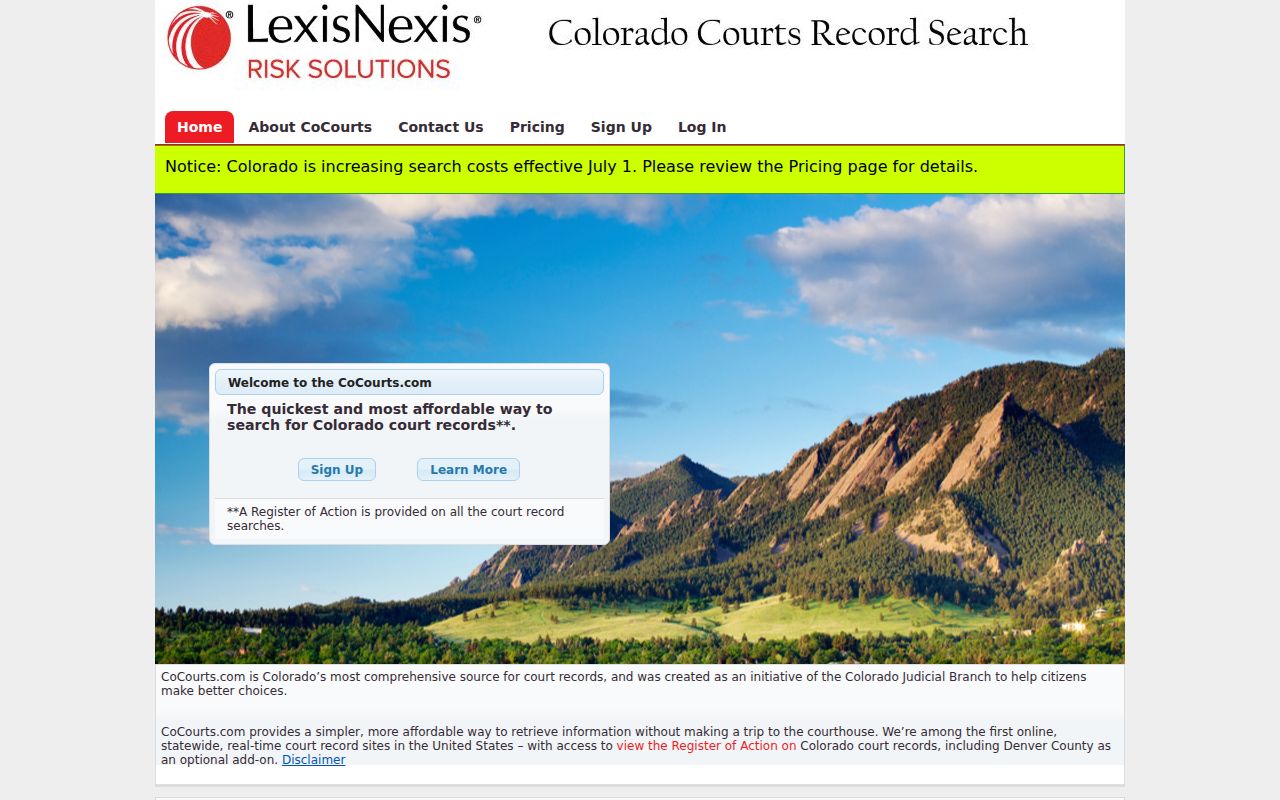
The search screen routes a reader toward register-of-actions data, while Kiowa County documents remain a Combined Court product.
What a Criminal Case File Contains
A Kiowa County case file traces what prosecutors filed and what the court did. It can show the complaint or information, bond events, counsel, hearing settings, motions, pleas, orders, disposition, and sentence. These judicial facts can differ from the charge first written on an arrest or booking record. The disposition is the court's final outcome for each count.
| Case number and court | Identifies the file, location, division, filing date, type, and status. |
|---|---|
| Charging document | States filed allegations, statutes, and felony, misdemeanor, or petty-offense labels. |
| Register of actions | Lists events, filings, orders, bond entries, counsel, judge, and financial assessments. |
| Hearing dates | Shows scheduled court events, which may change after the docket is published. |
| Disposition and judgment | Records dismissal, plea, acquittal, conviction, or another outcome by count. |
| Sentence and conditions | Shows the court-ordered sentence, restitution, probation, or custody terms that are public. |
Kiowa Certified Court Dispositions
A certified disposition is useful when a plain index entry does not settle the outcome. Contact the clerk at 719-931-6010, identify the case, and state that certification is needed. The local schedule lists a $5 name search, $0.25 per page, a $20 certified or exemplified copy per document, a $25 judgment transcript, and a $20 certificate of satisfaction. A party or attorney has a $15 page-copy maximum, while a nonparty has no page-count maximum.
Off-site retrieval is billed at actual cost. Research and redaction cost $30 per hour in 15-minute increments after the first hour. Transcript requests use JDF 4 and an estimate or deposit process. Ask for a quote because the right product may be a short certified disposition rather than a full file.
The official Judicial Branch form library provides searchable court forms, including sealing materials. Its captured interface shows why the exact form number and remedy matter.
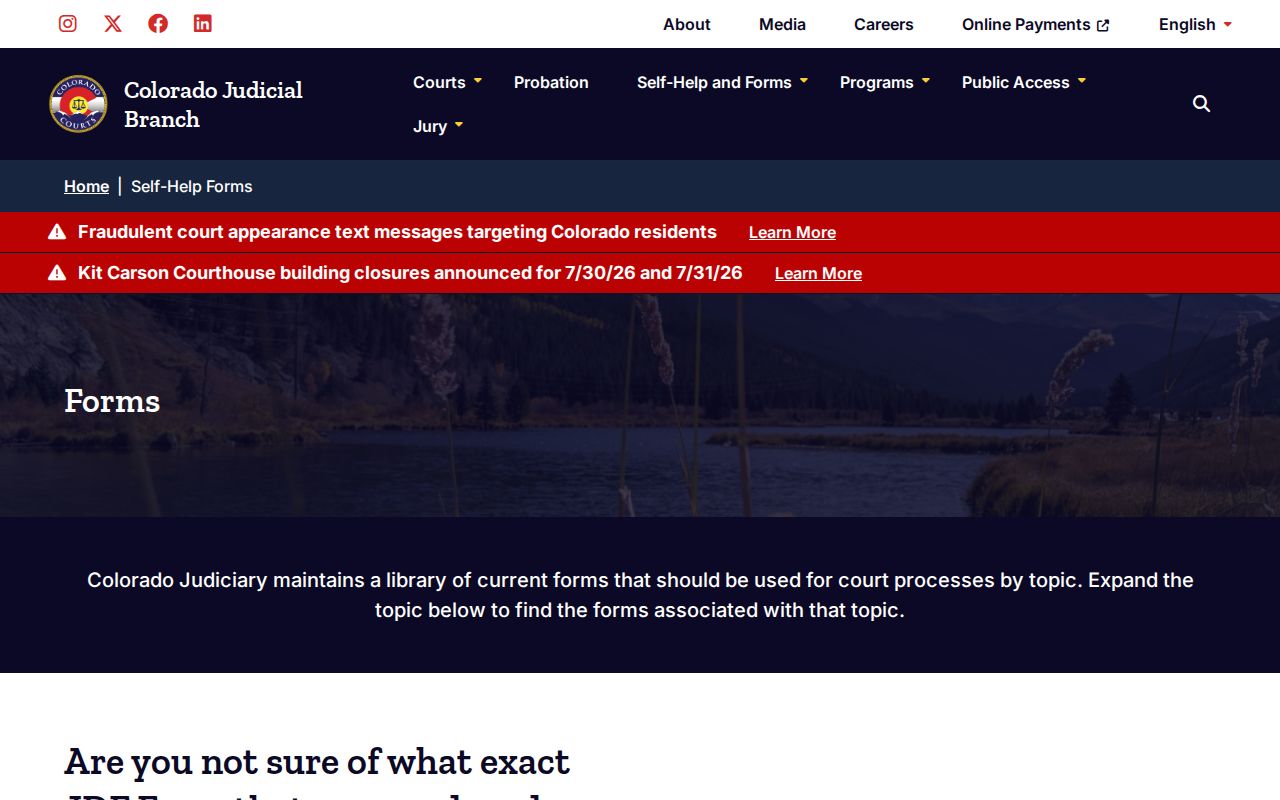
Forms support a filing task, but the Combined Court clerk supplies the filed Kiowa County record and certified result.
Criminal Case Stages in Kiowa County
The prosecutor's filed charge starts the court case. At arraignment, charges and a plea are addressed. Pretrial events can include motions, discovery issues, bond review, and plea talks. The case then ends through dismissal, a plea, or trial. A conviction moves to disposition and sentencing. The register of actions records this path, though it may use brief labels rather than a full account of what occurred in court.
Case flow: Charges Filed › Arraignment › Pretrial › Plea or Trial › Disposition › Sentencing
Booking charges can change before filing, and filed counts can change again. For that reason, the final order and disposition should control an outcome check. The broader Kiowa County arrest search explains the separate agency record created before a prosecution begins.
When Kiowa Court and CBI Differ
CBI criminal history groups fingerprint-supported arrest cycles with dispositions reported back from courts. A Kiowa County file can show a final result while CBI still says the disposition is unknown. That gap does not change the court order. Obtain official court documentation, then follow CBI's disposition-update or identity-correction instructions.
The CBI sealing instructions explain the repository step after a court order enters. The captured agency page keeps correction and sealing work tied to CBI rather than to an unofficial data broker.
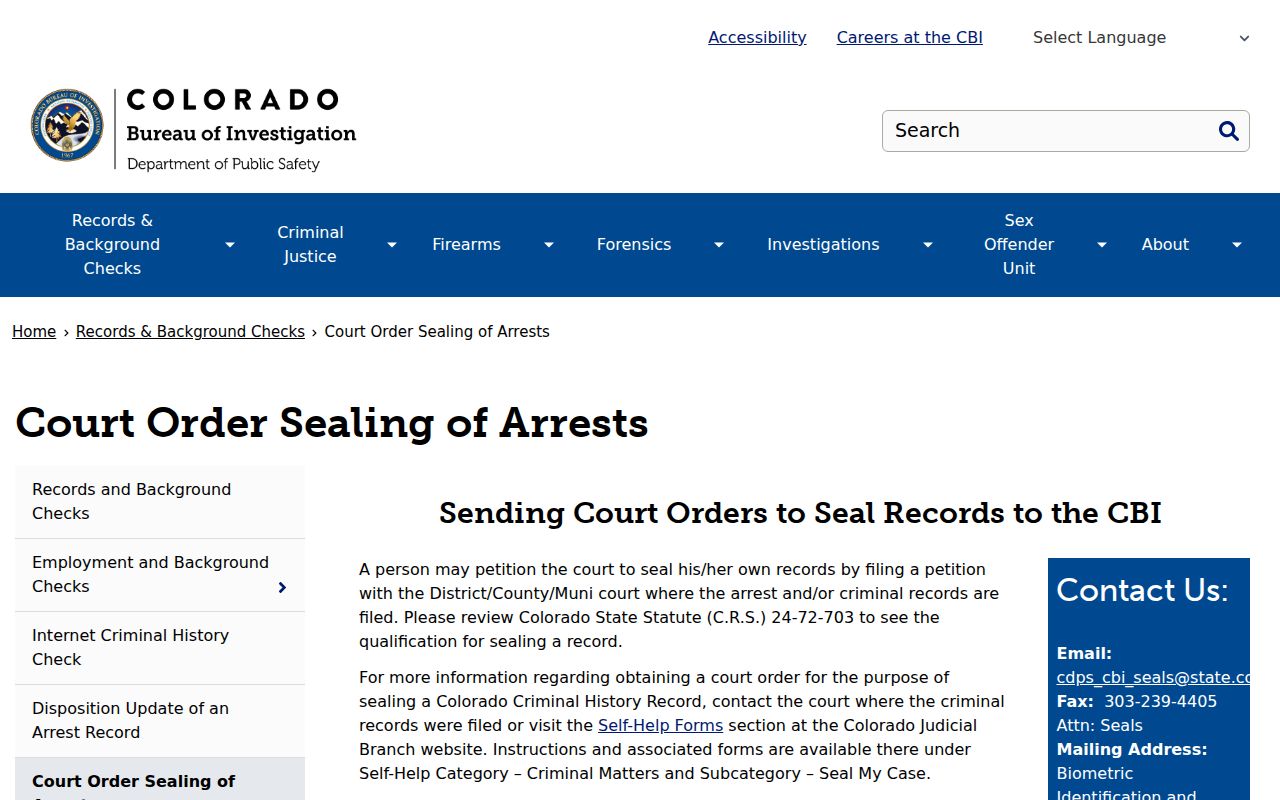
A signed order should reach every named custodian, and a later self-review can test whether CBI implemented the change.
Access Rules for Case Records
Colorado court records are subject to access rules, sealing orders, and specific protections. Public views may omit full dates of birth, protected addresses, victim names, juvenile information, sealed matters, and sensitive identifiers. An online result may also lack document images. Ask the clerk whether a public register of actions, a particular pleading, or a redacted copy can be released.
CORA, C.R.S. section 24-72-203, governs public records subject to exceptions. The CCJRA, especially sections 24-72-303 through 24-72-305, governs criminal justice records. Adult sealing provisions appear at sections 24-72-701 through 24-72-709. These laws do not turn every item into an online record, and a court order can restrict otherwise searchable material.
Access point: A missing name may reflect sealing, juvenile status, index limits, or the wrong date range. Confirm the official file with the Combined Court clerk.
The Colorado Judicial Branch probation page routes supervision questions that arise after sentencing.
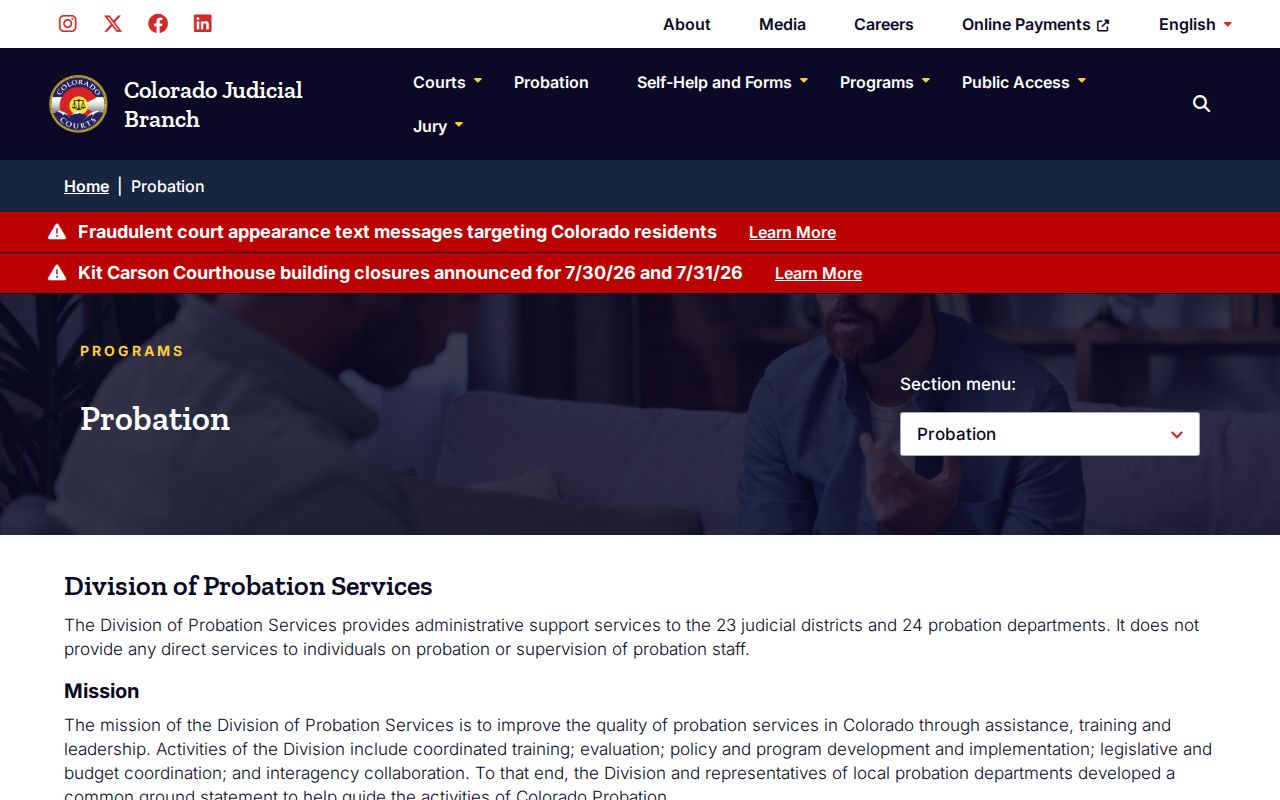
The sentencing entry remains in the court file, while day-to-day probation records can stay restricted.
Reading Kiowa Criminal Case Labels
Colorado case entries may shorten an offense level to F4, M1, or a petty-offense label. F4 means a class 4 felony, while M1 means a class 1 misdemeanor. The abbreviation alone is not enough to calculate a possible sentence. Read the charged statute, offense date, enhancements, plea, disposition, and sentencing entry. Drug offenses can follow separate provisions, and an older offense may be governed by the law in force when it occurred.
Other terms describe events rather than outcomes. An arraignment addresses charges and plea. A register of actions is the chronological event index. A docket may mean scheduled court matters. A deferred judgment delays judgment while conditions are completed. A dismissal ends a charge without conviction. These distinctions help a reader avoid treating every line as a finding of guilt.
Access also depends on choosing the right product. A register gives the event sequence. A charging document states what prosecutors filed. A final disposition records the court's action. A certified copy adds the clerk's formal authentication. Ask for the narrow document that answers the question, since a full file can add copy, retrieval, research, and redaction costs.