
Eads Agency Identification
Agency identification is the first practical safeguard in an Eads records search. U.S. 287 and Colorado 96 pass through the local area, so a road event may involve Colorado State Patrol even when an Eads address appears on paperwork. A town-area call may involve the sheriff. Activity tied to federal land or a federal investigation may produce another layer. Write down the badge, unit, road, direction, mile marker, date, and time before requesting anything. These facts let staff distinguish one event from another without relying on a broad name search.
After identifying the agency, match the request to the record. The creating police agency owns the incident narrative. The actual receiving jail owns its intake and housing data. Combined Court owns the filed case. CBI owns the statewide fingerprint-supported history. Each office can truthfully report no record when the request belongs elsewhere. That does not prove the event never occurred. It means the search must follow the Eads record flow.
A narrow report request should list the subject, incident or booking number when known, precise date range, location, record type, desired delivery format, certification need, and fee limit. Ask whether identification or a release is required. No official Eads source supports assuming email, fax, or a drop box is accepted. The sheriff should confirm the current method.
Older Eads files may require staff research or off-site retrieval. Court staff can quote those costs, while sheriff staff can quote report and video products. Separating the requests also protects accuracy: a certified court disposition proves the court outcome, while an arrest report records what officers documented at the event.
Eads Criminal History Checks
Eads is the county seat, yet it does not have a verified independent police department or public town criminal-record portal. Start with the agency named on the ticket, report, receipt, or court notice. The Kiowa County Sheriff handles the town's practical law-enforcement channel. Colorado State Patrol may hold a highway report. The Combined Court clerk handles a case only after charges are filed.
A sound Eads criminal history check follows five distinct steps:
- Identify whether the sheriff, State Patrol, or another agency responded.
- Ask that agency for the narrowly described incident or arrest report.
- Call the sheriff for present custody, booking, or warrant confirmation.
- Check the Combined Court for filed charges, settings, and dispositions.
- Use CBI ICHC when a statewide Colorado name result is needed.
Each channel can be right while showing different facts. A report describes an event. A court file records the prosecution. CBI compiles fingerprint-supported Colorado history.
Eads Records at Goff Street
Two important Eads custodians share 1305 Goff Street, but their files are not shared counter products. The Kiowa County Sheriff receives requests about incident reports, arrests, warrants, and custody. The Kiowa County Combined Court supplies filed cases, registers of actions, copies, and certified dispositions. Sheriff questions use 719-438-5411. Court-record questions use 719-931-6010.
Kiowa County Sheriff
1305 Goff Street
P.O. Box 427
Eads, CO 81036
719-438-5411
Kiowa Combined Court
1305 Goff Street
P.O. Box 353
Eads, CO 81036
719-931-6010
The shared address can mislead visitors. Ask for the office, record family, and service before traveling.
Records at the Eads Police Department
No separate Eads Police Department was verified. That absence is the key local fact, not a gap to fill with a commercial search. The sheriff is the town's local law-enforcement fallback. A requester should give a name, event date or range, location, incident number if known, desired format, and a focused description. The sheriff decides what may be released under Colorado criminal-justice records law.
Official sources differ on the sheriff's first-name spelling and fax number. The stable office number is the safer route. Ask staff for the current form, submission method, fee quote, identification rule, and physical-counter hours. Active investigations, juvenile material, victim details, and protected identifiers may be withheld or redacted.
Eads Arrests Without City Police
An Eads arrest may begin with the sheriff or Colorado State Patrol. The agency that made the arrest owns its incident report. The sheriff can confirm booking and identify the county that physically houses a detainee because Kiowa County says it does not operate a jail. There is no verified public Eads booking log.
For a recent event, record the badge, patrol car marking, highway, direction, mile marker, date, and time. Request a Patrol-created report from Patrol, not the town or court. Ask the sheriff where the person was taken. Filed charges later belong to the court clerk. The broader Kiowa County arrest search explains those county channels in more depth.
Booking and Arrest Records in Eads
Booking does not prove guilt. It creates an intake record tied to custody, identity, property, and the allegations known at that point. Charges may change when the district attorney reviews the event. Since no official county roster was verified, the practical Eads method is to call 719-438-5411 or dispatch at 719-254-3344 and ask which facility holds the person.
Contact the actual holding county for mail, calls, deposits, visitation, release, and bond delivery. Do not send bond funds to an inmate. A CDOC search is not the first tool for a new Eads arrest because CDOC covers state prison and correctional supervision after later case stages.
Record flow: Eads event › Sheriff or State Patrol report › outside holding facility › Kiowa Combined Court.
Eads Court Counter Week
The Eads court counter is open Monday through Thursday from 8:00 a.m. to noon and 12:30 to 4:30 p.m. It lists no Friday counter hours. The midday closure matters for a long rural trip. Call first for current instructions, accessibility needs, interpreter service, security rules, and the availability of an older file.
The clerk accepts cash, check, money order, Visa, Mastercard, and Discover at the counter. Mailed payments cannot be cash and should identify the person and case. These payment facts do not describe a records request. Paying a balance does not order an incident report or certified disposition.
Plan first: Friday is not a listed Eads court-counter day, and the counter closes for thirty minutes at midday.
The Eads Municipal Court File
No verified Eads municipal-court portal, docket, fee schedule, or regular session was found. A town-code question should begin with town administration to identify whether a local tribunal holds it. State misdemeanors, traffic matters, felony complaints, and district felonies route to the Combined Court. Do not assume a town citation appears in a statewide index.
| Court Name | No separate Eads municipal court was verified; confirm ordinance matters with town administration. |
|---|---|
| Case Types | Combined Court handles Colorado District and County Court criminal work. |
| Lookup Channel | Call or visit the clerk; use the state docket search for future settings. |
| File Contents | Charges, events, pleas, orders, disposition, and sentence when filed. |
| Copies | Request ordinary, certified, or exemplified documents from the clerk. |
The public docket is a lead, not the complete Eads court file.
Certified Eads Criminal Dispositions
A certified disposition is a clerk-authenticated record of the court outcome. It is often the best evidence when a CBI result shows an unknown or stale disposition. Give the clerk the name, case number if known, approximate filing year, and exact document needed. Ask whether off-site retrieval or research time applies before authorizing work.
| Clerk service | Researched amount |
|---|---|
| Paper copy | $0.25 per page |
| Name search | $5 |
| Certified or exemplified copy | $20 per document |
| Judgment transcript | $25 |
| Certificate of satisfaction | $20 |
| Research or redaction | $30 per hour after the first hour, billed in 15-minute units |
A party or attorney has a $15 page-copy maximum; a nonparty has no page-count maximum. Off-site retrieval is billed at actual cost.
How Eads Records Reach the County
An Eads incident can produce several records at different speeds. The responding agency writes the report. Booking staff create an intake record and may take fingerprints. The prosecutor chooses filed charges. The Combined Court clerk opens the case and records each event. A final disposition should then return to CBI.
Record flow: Eads sheriff or Patrol record › Kiowa County Combined Court › Colorado Bureau of Investigation.
CBI's Internet Criminal History Check is a Colorado-only name search and currently costs $6 per downloaded result. It can omit sealed cases, specified juvenile and young traffic arrests, or an event that never entered the fingerprint chain. The local file remains vital when the statewide result is incomplete.
Eads Sheriff Report Versus Court File
The report and court file answer different questions. The sheriff report can describe the call, observations, arrest basis, and collected evidence, subject to release limits. The court file shows the charge selected by the prosecutor, hearings, pleas, motions, orders, outcome, and sentence. One cannot substitute for the other.
- Incident report
- The creating agency's account of a reported event and response.
- Register of actions
- The clerk's chronological list of filings and court events.
- Disposition
- The recorded outcome, such as dismissal, plea, or verdict.
- Certified copy
- A copy authenticated by the official custodian.
When CBI and the court disagree, obtain official court proof and follow CBI's correction route.
Eads Criminal Record Statistics
The Census Vintage 2025 estimate places Eads at 642 residents. That small base makes percentages volatile. A few events can cause a large rate change. CBI crime data should be filtered to the Kiowa County Sheriff's reporting agency and labeled countywide, not presented as an Eads police series.
The Census county table provides context for the scale of local records.
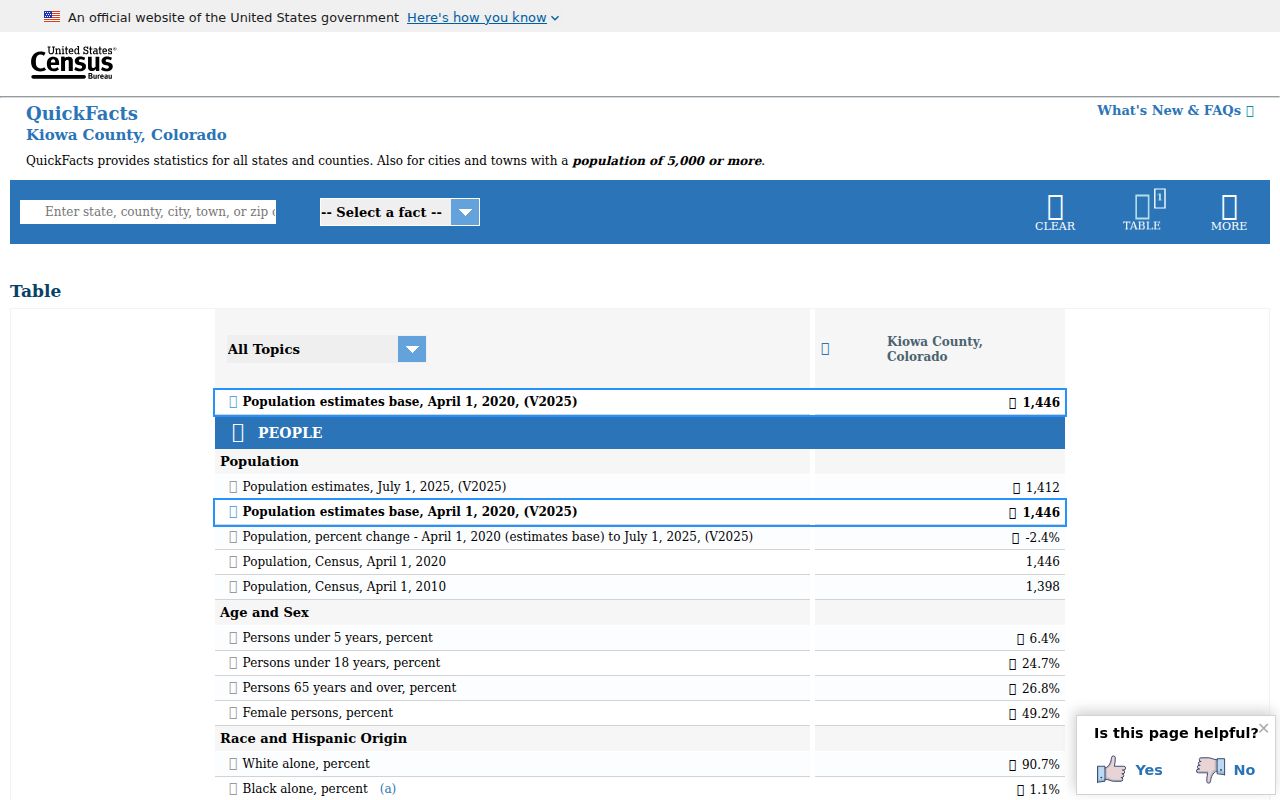
This official demographic view helps explain why raw counts and multi-year trends are more useful than a single Eads percentage.
Colorado NIBRS counts each offense within an incident, not only the most serious offense. Later agency corrections can revise totals. A cleared offense is not the same as a conviction.
Eads Town Hall Is Not Court
Town administration and county justice offices have different roles. Town Hall can identify an ordinance process or confirm whether a local record exists. It does not replace the sheriff for an arrest report or the Combined Court clerk for a state criminal case. The distinction is especially important in Eads because the county offices are physically prominent.
The official Town of Eads source shows the local government setting.
The town image provides local context, while criminal-record requests still follow the custodian that created the file.
Eads Record Access Rules
Colorado criminal-justice records are governed chiefly by the CCJRA, while CORA covers other public records. A custodian weighs disclosure, redaction, privacy, case status, and statutory restrictions. A narrow request for a known final report, booking sheet, or court document is more workable than a demand for every record about a person.
Key statutes:
Colorado Criminal Justice Records Act, C.R.S. §§ 24-72-301 through 309 governs access to criminal-justice records and custodian review.
Colorado Open Records Act, C.R.S. §§ 24-72-200.1 through 205 governs many non-court public records.
Colorado Judicial public-record access rules explain that court documents generally come from the clerk.
Sealed files, juvenile information, victim details, medical facts, protected identifiers, and active investigative material may be restricted. Verify the current route with the holding office.